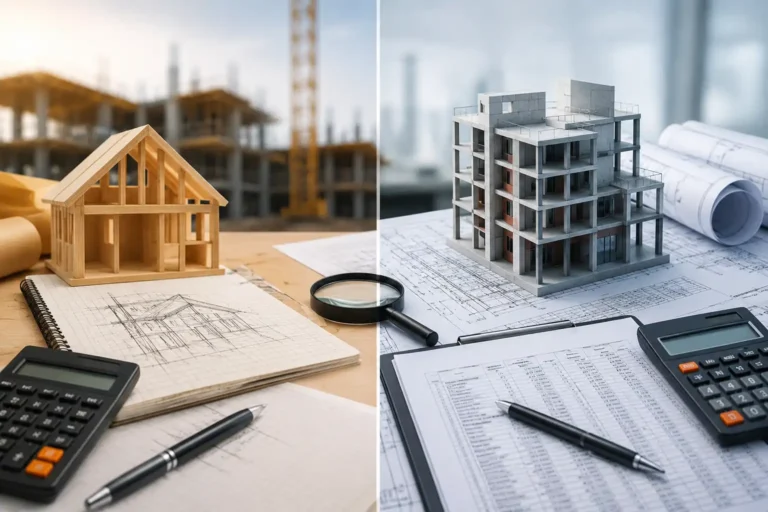
Construction cost estimating is one of the most important steps before starting any building project. Whether you are planning a new home, bidding on a commercial project, preparing an industrial facility, or reviewing a renovation budget, you need clear numbers before moving forward.
A construction estimate gives you a detailed understanding of expected project costs. It can include materials, labor, equipment, subcontractors, sitework, overhead, profit, contingency, and other expenses that affect the final budget. Without a reliable estimate, it becomes easy to underprice a project, overspend on materials, miss important scope items, or face budget problems during construction.
In the USA, construction costs can vary by project type, location, labor availability, material pricing, building requirements, and design complexity. A residential home in Florida, a warehouse in Texas, a restaurant in New York, and an industrial facility in California will not have the same cost structure. That is why accurate estimating is not just about adding numbers together. It requires a clear review of drawings, specifications, quantities, trade scopes, and real construction conditions.
This guide explains how construction cost estimating works, what should be included in a detailed estimate, how material takeoffs support better budgeting, and when it makes sense to use professional construction cost estimating services in USA for your project.
What Is Construction Cost Estimating?
Construction cost estimating is the process of calculating the expected cost of a construction project before work begins. It helps homeowners, contractors, builders, developers, architects, property owners, and construction companies understand how much money may be needed to complete the project.
A good estimate does more than provide a single total price. It breaks the project into clear cost categories so the project team can review materials, labor, equipment, trade work, overhead, profit, and possible risk items.
Construction estimating is commonly used for planning a new project, preparing a budget, comparing contractor bids, submitting a construction bid, ordering materials, reviewing feasibility, and reducing the risk of budget overruns.
A rough estimate may be useful in the early planning stage, but a detailed estimate gives better financial clarity. The more complete the drawings and scope are, the more accurate the estimate can become.
Who Needs Construction Cost Estimating Services?
Construction estimating is not only for contractors. Many people and businesses need accurate cost estimates before making important construction decisions.
Homeowners
Homeowners need cost estimates when planning a new home, an addition, a renovation, a kitchen remodel, a basement finish, a garage build, or a multi-family property. A clear residential construction cost estimate helps homeowners understand expected costs before hiring contractors or committing to a project.
For homeowners, estimating is especially useful because many project costs are easy to overlook. Framing, roofing, drywall, flooring, plumbing, electrical work, HVAC, painting, permits, site conditions, and finishes can all affect the final budget.
Contractors and Subcontractors
Contractors use estimates to prepare bids, protect profit margins, schedule crews, and order materials. If the estimate is too high, they may lose the project. If it is too low, they may win the job but lose money during construction.
Subcontractors also need accurate estimates for specific trades such as concrete, lumber, electrical, plumbing, mechanical, drywall, painting, flooring, masonry, and sitework. A detailed estimate helps them price their scope correctly and avoid missing important items.
Builders and Construction Companies
Builders and construction companies use estimates to manage budgets, plan procurement, assess labor needs, and maintain financial control over projects. Accurate estimating helps them understand costs before materials are ordered and before work begins on site.
Developers and Property Owners
Developers and property owners need estimates to check whether a project is financially realistic. Before buying land, approving drawings, seeking financing, or starting construction, they need to understand the likely cost of the project.
A reliable estimate can help developers compare design options, review investment potential, and avoid moving forward with a project that does not fit the budget.
Architects and Designers
Architects and designers often need estimating support during early planning. A design may look strong visually, but it also needs to fit the client’s budget. Estimating helps connect design decisions with financial reality before the project moves too far into development.
What Is Included in a Construction Cost Estimate?
A complete construction cost estimate should clearly explain where the money is expected to go. Instead of showing only one total number, it should break the project into understandable categories.
A detailed construction estimate may include material quantities, material pricing, labor costs, equipment costs, subcontractor costs, sitework and preparation, concrete, framing, drywall, finishes, MEP systems, permits, waste factors, overhead, profit, contingency, assumptions, and exclusions.
The exact estimate format depends on the project type and available information. A residential project may focus on framing, roofing, windows, doors, drywall, flooring, cabinets, plumbing, electrical systems, and finishes. A commercial project may include tenant improvements, structural work, fire protection, HVAC, accessibility requirements, and specialized finishes. An industrial project may require heavier structural systems, equipment foundations, large utilities, mechanical systems, and complex electrical requirements.
For better planning, the estimate should be clear enough to support budgeting, bidding, procurement, and decision-making.
Construction Estimate vs Material Takeoff
A construction estimate and a material takeoff are connected, but they are not the same thing.
A material takeoff focuses on quantities. It identifies how much material is required from the drawings and specifications. This may include concrete volume, lumber quantities, drywall sheets, flooring area, paint coverage, masonry units, plumbing pipe, electrical fixtures, and other measurable items.
A construction estimate goes further. It uses the quantities from the takeoff and adds pricing for materials, labor, equipment, subcontractors, overhead, profit, and other project costs.
In simple terms, a material takeoff shows what materials are needed, while a construction estimate shows what the project may cost.
For example, a drywall takeoff may calculate the number of drywall sheets, screws, joint compound, corner beads, and insulation required. A drywall estimate then adds pricing, labor, equipment, waste, and installation costs.
If your project needs accurate quantities before pricing, professional material takeoff services can help reduce waste, avoid shortages, and support better cost planning.
Main Types of Construction Estimates
Different project stages require different types of estimates. The right estimate depends on how much information is available and what decision needs to be made.
Preliminary Construction Estimate
A preliminary estimate is created during the early planning stage. It is useful when drawings are not fully complete, but the project owner still needs a budget range.
A preliminary construction estimate can help homeowners, developers, architects, and property owners check project feasibility before investing more time and money into design or construction planning.
Preliminary estimates are commonly used for early budgeting, feasibility studies, design planning, financing discussions, project scope review, and comparing different construction options.
Detailed Construction Estimate
A detailed estimate is prepared when drawings, specifications, and project scope are more complete. It includes a deeper breakdown of quantities, materials, labor, equipment, trades, and cost categories.
Detailed estimates are useful for bidding, procurement, project planning, and construction cost control.
Bid Estimate
A bid estimate is prepared when a contractor or subcontractor needs to submit pricing for a project. Accuracy is very important because the estimate affects both competitiveness and profitability.
A strong bid estimate should include the full scope of work, realistic pricing, labor assumptions, overhead, profit, and exclusions.
Quantity Takeoff
A quantity takeoff focuses on measuring materials from the project drawings. It supports both estimating and procurement. Quantity takeoffs are useful for contractors, subcontractors, builders, suppliers, and project managers.
Trade-Specific Estimate
A trade-specific estimate focuses on one scope of work, such as concrete, lumber, electrical, plumbing, mechanical, drywall, painting, flooring, masonry, or sitework. These estimates are useful when a project requires detailed pricing for a specific construction trade.
Residential Construction Cost Estimating
Residential construction estimating focuses on homes, townhouses, apartments, multi-family buildings, additions, remodels, and renovations. These projects often include sitework, foundation, framing, roofing, insulation, drywall, flooring, painting, cabinetry, plumbing, electrical systems, HVAC, and finishes.
A residential estimate should be clear because homeowners and builders often need to make decisions about design, materials, finish levels, and budget priorities. Even small changes in flooring, cabinets, windows, roofing, fixtures, or layout can change the total cost.
Residential estimating may include new home construction estimates, home addition estimates, remodeling estimates, multi-family building estimates, framing and lumber takeoffs, drywall and finish estimates, plumbing, electrical, HVAC estimates, flooring estimates, and painting estimates.
For homeowners, the biggest benefit is budget clarity. For builders, the biggest benefit is better planning and more accurate bidding.
Commercial Construction Cost Estimating
Commercial construction estimating is used for offices, retail stores, restaurants, hotels, warehouses, medical offices, schools, mixed-use buildings, and other business-related projects.
Commercial projects often require more coordination than smaller residential projects. They may include structural work, fire protection, mechanical systems, electrical systems, plumbing systems, accessibility requirements, commercial finishes, sitework, and code-related items.
Professional commercial construction estimating services help contractors, business owners, developers, and construction companies understand project costs before moving forward.
Commercial estimating may include office building estimates, retail store estimates, restaurant construction estimates, warehouse estimates, tenant improvement estimates, medical office estimates, hotel and hospitality estimates, and commercial renovation estimates.
A restaurant may require specialized plumbing, kitchen ventilation, grease traps, fire suppression, and durable finishes. A warehouse may focus more on slab design, structural steel, loading areas, lighting, electrical service, and site access. An office project may require partitions, ceilings, flooring, HVAC, lighting, and technology infrastructure.
Because commercial projects involve many moving parts, a detailed estimate helps reduce risk and supports better planning.
Industrial Construction Cost Estimating
Industrial construction estimating is used for factories, plants, manufacturing facilities, distribution centers, processing facilities, warehouses, and large-scale infrastructure-related projects.
Industrial projects often involve heavy structural systems, large concrete scopes, specialized equipment, utility requirements, mechanical systems, electrical systems, process piping, site development, and strict coordination.
A detailed industrial construction cost estimate helps project teams identify major cost drivers early and avoid expensive planning mistakes.
Industrial estimating may include manufacturing facility estimates, plant expansion estimates, distribution center estimates, warehouse construction estimates, heavy concrete estimates, steel and structural estimates, mechanical and electrical system estimates, and sitework and utility estimates.
Industrial projects can be complex, so the estimate should be organized, detailed, and based on a careful review of drawings, specifications, and project requirements.
Trade-Specific Construction Estimating
Many construction projects need trade-specific estimates in addition to a full project estimate. This helps break down individual scopes of work and gives contractors, subcontractors, builders, and project owners a clearer view of cost details.
Estimate Lift provides construction trades estimating services across multiple scopes.
Concrete Estimating
Concrete estimating includes slabs, footings, foundations, walls, columns, beams, rebar, formwork, concrete volume, placement, finishing, and labor. A detailed concrete estimating service helps reduce waste, improve budget accuracy, and support better planning for residential, commercial, and industrial projects.
Lumber Takeoff
Lumber takeoff focuses on framing materials such as studs, joists, rafters, beams, trusses, sheathing, plywood, and engineered lumber. Accurate lumber takeoff services help builders and contractors order the right materials and avoid overbuying or underordering.
Electrical Estimating
Electrical estimating includes wiring, panels, fixtures, conduit, switchgear, lighting, outlets, devices, low-voltage systems, and labor. Professional electrical estimating services are important because missing electrical scope can create major budget issues during construction.
Plumbing Estimating
Plumbing estimating includes pipes, fittings, fixtures, valves, drainage systems, water supply lines, trenching, rough-ins, and labor. A detailed plumbing estimate helps contractors and project owners understand plumbing costs before installation begins.
Mechanical Estimating
Mechanical estimating often covers HVAC systems, ductwork, piping, insulation, ventilation, equipment, and related labor. A professional mechanical estimate is important for projects where mechanical systems represent a large part of the budget.
Drywall Takeoff
Drywall takeoff includes drywall sheets, screws, joint compound, corner beads, insulation, finishing levels, and labor. Accurate drywall takeoff services help contractors prepare bids, plan material orders, and reduce installation delays.
Painting, Flooring, Masonry, and Sitework
Other important trade estimates include painting estimating services, flooring estimating services, masonry estimating services, and sitework estimating services.
These scopes can have a major effect on the final budget. Site conditions, finish selections, labor requirements, quantities, and project complexity can all change the cost.
How to Estimate Construction Costs Step by Step
The estimating process may vary by project, but most professional construction estimates follow a structured workflow.
1. Review the Drawings and Specifications
The first step is to study the drawings, plans, and specifications. This helps the estimator understand the project scope, building type, materials, systems, and construction requirements.
The estimator reviews architectural, structural, civil, mechanical, electrical, plumbing, and finish details when available.
2. Define the Scope of Work
The estimator identifies what is included and what is excluded. Scope clarity is essential because many estimating mistakes happen when assumptions are not documented.
For example, sitework, demolition, permits, utility connections, equipment, landscaping, and specialty finishes may be excluded unless clearly included in the project documents.
3. Perform the Quantity Takeoff
The next step is measuring quantities from the drawings. This may include concrete volume, square footage, linear footage, fixture counts, framing materials, drywall sheets, flooring area, paint coverage, pipe lengths, conduit runs, and other project-specific items.
A detailed takeoff helps create the foundation for an accurate estimate.
4. Price the Materials
After quantities are measured, material costs are applied. Pricing should consider project location, material specifications, supplier availability, current market conditions, and waste factors.
Material prices can change, so outdated pricing can make an estimate unreliable.
5. Calculate Labor Costs
Labor costs depend on project location, productivity, crew size, project complexity, schedule, site conditions, and trade requirements.
Labor is one of the most important parts of an estimate because incorrect labor assumptions can quickly affect the project budget.
6. Add Equipment and Subcontractor Costs
Some projects require equipment rental, lifts, cranes, pumps, excavation equipment, temporary systems, or specialty subcontractors. These costs should be included when applicable.
7. Add Overhead, Profit, and Contingency
A complete estimate should include overhead, profit, and contingency. Overhead covers business or project-related indirect costs. Profit supports the contractor’s margin. Contingency helps cover reasonable unknowns, especially when the project is still in an early stage.
8. Review the Estimate
Before finalizing the estimate, the estimator should review all quantities, pricing, assumptions, exclusions, and cost categories. This quality check helps catch missing items and improves confidence in the final numbers.
Common Construction Estimating Mistakes
Even experienced project teams can make estimating mistakes. The most common issues usually come from missing scope, unclear assumptions, or weak pricing.
Missing Scope Items
Missing scope is one of the biggest causes of inaccurate estimates. If an estimator overlooks sitework, demolition, labor, equipment, finishes, or trade-specific items, the budget may be too low.
Using Outdated Material Prices
Material prices can change over time. Estimates based on old pricing may not reflect current market conditions. This is especially important for lumber, steel, concrete, copper, drywall, mechanical equipment, and electrical materials.
Ignoring Site Conditions
Site conditions can affect excavation, grading, drainage, access, utilities, soil preparation, and equipment needs. A difficult site may cost more than a similar project on a clear, level site.
Underestimating Labor
Labor costs are not only about hourly rates. Productivity, project complexity, working conditions, schedule pressure, trade coordination, and local labor availability can all affect the final labor cost.
No Contingency
Projects often include unknowns. Without contingency, even small changes can create budget pressure. Contingency is especially useful during early planning when drawings are not fully complete.
Unclear Assumptions and Exclusions
Every estimate should explain what is included and what is excluded. If assumptions are unclear, the client, contractor, or project owner may misunderstand the budget.
Why Accurate Construction Estimating Matters
Accurate estimating helps construction projects move forward with fewer financial surprises. It supports better planning, better bidding, better procurement, and better communication between everyone involved.
For homeowners, a reliable estimate helps confirm whether the project fits the available budget. For contractors, it supports competitive bidding and profit protection. For developers, it helps evaluate feasibility and financing. For architects, it helps align design with cost expectations. For construction companies, it supports scheduling, procurement, and project control.
A strong estimate also helps avoid over-ordering and under-ordering materials. Ordering too much material wastes money. Ordering too little can delay the project. Accurate quantities and pricing help create a smoother construction process.
When Should You Hire a Professional Construction Estimating Company?
You should consider hiring a professional estimating company when accuracy, time, or project complexity matters.
Professional estimating support is useful when you need a bid estimate quickly, do not have an in-house estimator, are reviewing multiple projects at once, have drawings that include several trades, need a detailed material takeoff, are planning a project in a different state, want to compare contractor pricing, need early budget clarity, or want to reduce the risk of missing important cost items.
A professional estimating team can review your drawings, prepare takeoffs, apply pricing, organize the estimate, and help you understand the expected cost breakdown.
If you need help with a project, you can request a construction estimate quote and share your plans, drawings, or project details.
How Estimate Lift Helps With Construction Cost Estimating in the USA
Estimate Lift provides estimating support for homeowners, contractors, builders, architects, developers, project owners, and construction companies across the USA.
Whether you need a full project estimate, material takeoff, preliminary budget, or trade-specific estimate, the goal is to give you clear numbers before you make important project decisions.
Through Estimate Lift’s construction estimating services, clients can get support for residential, commercial, industrial, preliminary, material, and trade-specific estimating needs.
Estimate Lift can help with residential construction estimates, commercial construction estimates, industrial construction estimates, material takeoffs, preliminary estimates, concrete estimates, lumber takeoffs, electrical estimates, plumbing estimates, mechanical estimates, drywall takeoffs, painting estimates, flooring estimates, masonry estimates, and sitework estimates.
If you are planning a project, preparing a bid, comparing budgets, or ordering materials, a detailed estimate can help you move forward with more confidence.
Final Thoughts
Construction cost estimating in the USA requires more than a quick guess. Every project has its own scope, location, design, trade requirements, labor conditions, material needs, and cost risks.
A reliable estimate helps you understand those costs before construction begins. It gives you better control over your budget, schedule, materials, and project decisions.
Whether you are planning a home renovation, bidding on a commercial project, developing an industrial facility, or preparing a trade-specific scope, accurate estimating can help reduce risk and prevent costly surprises.
If you need accurate numbers before moving forward, professional construction estimating can help you plan smarter, budget better, and make more confident decisions from the start.
FAQs About Construction Cost Estimating in the USA
1. What is construction cost estimating?
Construction cost estimating is the process of calculating the expected cost of a construction project before work begins. It usually includes materials, labor, equipment, subcontractors, overhead, profit, contingency, and other project-related costs. A clear estimate helps homeowners, contractors, builders, developers, and project owners understand the expected budget before making construction decisions.
2. What is included in a construction cost estimate?
A construction cost estimate usually includes material quantities, labor costs, equipment costs, subcontractor pricing, sitework, trade-specific costs, permits, general conditions, overhead, profit, contingency, assumptions, and exclusions. The exact breakdown depends on whether the project is residential, commercial, or industrial.
3. How do you estimate construction costs in the USA?
To estimate construction costs in the USA, review the drawings and specifications, define the project scope, complete a material takeoff, price materials, calculate labor, add equipment and subcontractor costs, include overhead and profit, then review assumptions and exclusions. Local labor rates, material prices, project location, and building requirements can all affect the final estimate.
4. What is the difference between a material takeoff and a construction estimate?
A material takeoff measures the quantities of materials needed for a project, such as concrete, lumber, drywall, flooring, or fixtures. A construction estimate uses those quantities and adds pricing for materials, labor, equipment, overhead, profit, and other costs. In simple terms, a takeoff shows what is needed, while an estimate shows what it may cost.
5. Who needs construction cost estimating services?
Construction cost estimating services are useful for homeowners, contractors, subcontractors, builders, architects, developers, property owners, and construction companies. They help with project budgeting, bid preparation, material planning, cost comparison, financing decisions, and overall project planning.
6. Why is construction cost estimating important?
Construction cost estimating is important because it helps reduce financial risk before a project begins. A detailed estimate can prevent budget surprises, missed scope items, material shortages, underpriced bids, and poor planning decisions. It also helps project owners compare options and contractors submit more accurate bids.
7. How accurate is a construction cost estimate?
The accuracy of a construction cost estimate depends on the quality of the drawings, project details, scope clarity, current pricing, and estimating method. Early preliminary estimates are usually less precise because fewer details are available. Detailed estimates based on complete drawings and specifications are typically more reliable for budgeting and bidding.
8. What is a preliminary construction estimate?
A preliminary construction estimate is an early-stage cost estimate created before the project drawings are fully complete. It helps homeowners, developers, architects, and project owners understand whether a project is financially realistic before investing more time and money into design, engineering, or construction planning.
9. What is the difference between residential, commercial, and industrial estimating?
Residential estimating focuses on homes, renovations, additions, and multi-family projects. Commercial estimating covers offices, restaurants, retail spaces, warehouses, medical offices, and business facilities. Industrial estimating is used for factories, plants, manufacturing facilities, distribution centers, and projects with heavier structural, mechanical, electrical, or utility requirements.
10. When should you hire a construction estimating company?
You should hire a construction estimating company when you need accurate numbers, have limited time, do not have an in-house estimator, are bidding on multiple projects, need a detailed material takeoff, or want to reduce the risk of missing important cost items. Professional estimating support is especially useful for complex residential, commercial, industrial, and trade-specific projects.
Estimate Lift is a trusted construction estimating and takeoff partner serving contractors, builders, and developers across the United States. We provide accurate cost estimates, detailed quantity takeoffs, and bid support services to help construction professionals plan projects, control costs, and submit competitive bids with confidence.